

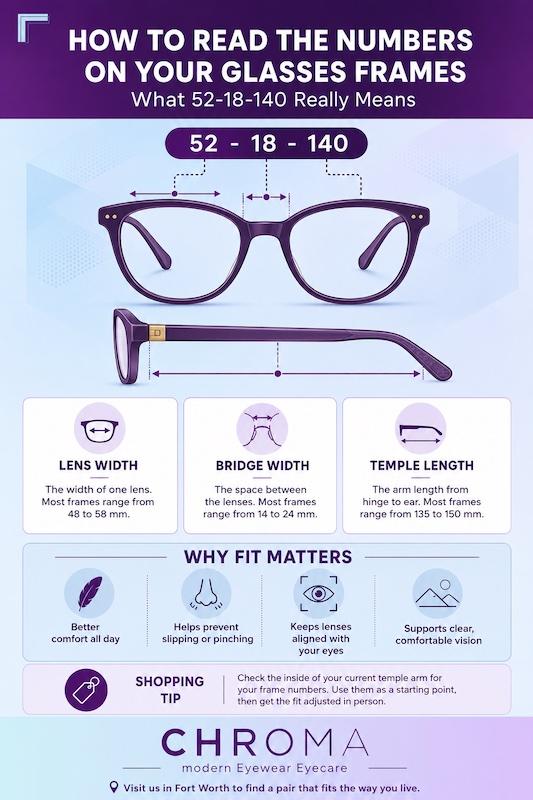
Take a look at the inside arm of your glasses. You’ll likely spot a sequence like 52-18-140 stamped near the hinge. Three numbers, no label, no explanation. It’s a code you’ve probably walked past a thousand times without a second thought. But those three digits tell you almost everything about whether a frame will actually fit your face.
Those numbers are a sizing code, measured in millimeters, that describes the physical dimensions of your frame across three specific points. They have nothing to do with your prescription or the style of the frame. They’re purely about fit, and fit matters more than most people realize. Here’s what each digit is telling you.
Cracking the Code on Your Frame Measurements
Those little numbers map out the specific geometry of your eyewear. Each one covers a different part of the frame, and here’s what they measure.
Lens Width
The first number is the lens width. It measures the horizontal width of one lens across the front of the frame. A common range is 48 to 58 millimeters, depending on the frame style.
This number affects how the frame looks on your face and how well your prescription lenses perform. If the lens sits too wide or too narrow relative to your pupil position, you may notice distortion at the edges of your vision.
Bridge Width
The second number is the bridge width, which is the gap between the two lenses. This small measurement has a big impact on how the frame sits on your nose.
A bridge that’s too narrow pinches. One that’s too wide lets the frame slide down throughout the day. Most frames fall between 14 and 24 millimeters here, and even a two-millimeter difference can change how the glasses feel after a few hours of wear.
Temple Length
The third number measures the temple arm, from the hinge all the way to the tip that curves behind your ear. Standard lengths run from about 135 to 150 millimeters.
Longer temples tend to create a more secure fit, especially for people with longer faces or ears set further back. If the arms sit too short, the frame rides forward. Too long, and they can poke or create pressure behind the ear.
Why Frame Measurements Matter for a Custom Fit
A frame that doesn’t fit your face correctly doesn’t just feel uncomfortable. It can move your lenses out of alignment with your pupils, which changes how clearly you see, even with a current prescription.
Personalized eyecare means your frame fit is matched specifically to your face shape, not just your number range. High-end eyewear and designer frames are crafted with tighter tolerances, so precise sizing matters even more for getting the clarity those lenses are designed to deliver. A few millimeters in the wrong direction and you’re not getting the full benefit of what you paid for.
Most of the time, your glasses will tell you when the fit is off. Look out for a few common signs:
- Your frames slip down your nose throughout the day
- You notice redness or marks on the bridge of your nose or behind your ears
- Your vision feels slightly off even though your prescription is current
- The frame sits crooked or uneven on your face
Any of these can usually be fixed with a simple adjustment, and that’s exactly the kind of thing a rushed big-box counter tends to miss.
How to Use Your Frame Numbers When Shopping for Designer Frames
Before you start trying on new frames, check the inside of your current temple arm. Those three numbers are your starting point. They tell you what has already worked for your face, so you’re not starting from scratch.
That said, numbers are a guide, not a guarantee of fit. Different frame shapes distribute weight differently. Different materials flex differently. Small changes in any measurement can noticeably shift daily comfort. That’s why a knowledgeable team goes beyond matching numbers and adjusts the frame to how it actually sits, on your face, your nose, your ears, the way no spec sheet can predict.
When you’re ready to explore, our featured lines like LaFont, Blackfin, Oliver Peoples, Kirk & Kirk, Lindberg, Tom Ford, and Etnia Barcelona each fit and flex a little differently, which is exactly why trying them on with a team that knows their tolerances beats guessing from a number.
Come See What Fits at CHROMA
Numbers can point you in the right direction, but the best part happens in person. Our team takes the time to learn how you actually live, then helps you explore featured frames and curated collections chosen for people who want eyewear with a point of view.
There’s no rushed recommendation and no timer running. We’ll pull the shapes that suit your face, dial in the fit until it sits exactly right, and make sure your eyewear feels as good as it looks by the time you walk out the door.
If your current glasses haven’t felt quite right lately, book online, call/text us, or stop by CHROMA modern Eyewear Eyecare in Fort Worth and let us take a look. Come in, try on something you love, and find a pair that fits the way you live.
It’s time to feel great in your frames.